Demonstration host
A representative site, utility constraints and an operating environment in which the pilot can be integrated and tested.

Direct air capture | Innovated
Air View Engineering develops practical direct air capture hardware, designed, assembled and tested to turn engineering evidence into the next generation of carbon-removal infrastructure.
Air View uses a modular, regeneration-led architecture that allows the major process functions to be developed independently, integrated as one system and tested against real deployment requirements.
Integrated pilot built. Supported by two Innovate UK Smart Grants. Now progressing towards site demonstration.
Direct air capture - illustrated
An illustrative animation of a sorbent-based direct air capture cycle. A fan draws ambient air, shown as blue particles, through a contactor holding a layered sorbent bed. Grey carbon-dioxide particles bind to the sorbent while carbon-dioxide-lean air leaves on the far side; a small share slips through as the bed fills. Dampers then seal the contactor, heat is applied, and the bound carbon dioxide is released through a separate outlet to collection before the sorbent cools and the cycle repeats. Proportions, timings and geometry are not to scale.
AdsorbFans draw ambient air through the sorbent bed. CO2 binds to the sorbent while CO2-lean air passes out.
Conceptual visual - a generic sorbent adsorb / regenerate cycle. Proportions, timings and geometry are illustrative, not to scale.
Choose your route
Follow the route most relevant to your organisation, your investment interest or your understanding of the technology.
The immediate opportunity | Gate 4
Pilot construction is complete. The next stage is to place the system in a defined operating context, commission it safely and generate independently reviewable data.
We are seeking organisations and investors that can help retire the next set of technical and deployment risks.
A representative site, utility constraints and an operating environment in which the pilot can be integrated and tested.
Measurement, modelling, test design and independent scrutiny that can turn operating results into credible evidence.
A storage or utilisation partner able to define conditioning, quality, accounting and commercial requirements.
Investment linked to site integration, commissioning and a test programme with defined evidence gates.
The work, as it is
An early-stage climate technology company should show the work-not hide behind a perfect future image.
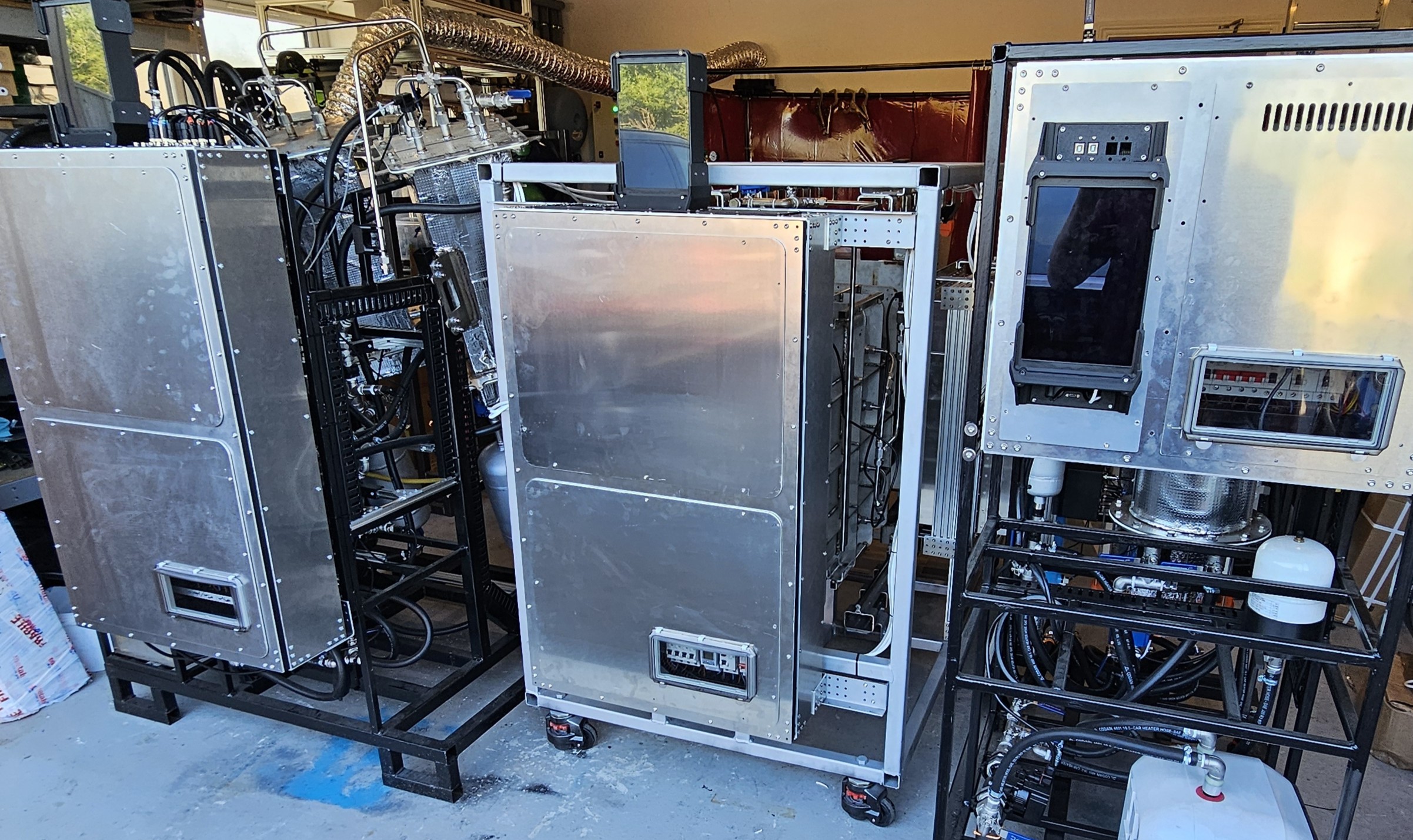
Our current prototype brings the major process elements together in a testable platform. It lets us learn from real components, real operating conditions and the difficult interfaces between them.
Why Air View | The development approach
Air View's difference is not based on an unverified performance claim. It is the way the platform is being engineered: around the complete process, the difficult interfaces and the evidence needed to move from pilot hardware towards working infrastructure.
The major process functions have been brought together in a configurable pilot platform, allowing component behaviour and the interfaces between subsystems to be tested as one system.
Our 2025 Innovate UK Smart Grant supported development aimed at a more energy-efficient regeneration approach for solid-sorbent direct air capture, treating regeneration as a system-level engineering challenge.
Design, fabrication, assembly and iteration are kept in-house wherever practicable. That preserves system knowledge, supports faster learning and keeps intellectual property close to the team building the technology.
Platform development considers the requirements of permanent storage and responsible CO2 utilisation, while keeping product value, carbon accounting and durable-removal claims clearly separated.
Public descriptions remain at principle level. Quantified performance claims will follow defined testing and appropriate validation.
Market reality | Reviewed monthly
A substantial carbon-removal market is forming, but contracted demand still runs far ahead of physical delivery. Closing that gap requires working systems, credible measurement and a disciplined route from prototype to infrastructure.
3.3% delivered
Durable carbon removal across all tracked methods, not direct air capture alone. Monthly snapshot: 17 July 2026. Source: CDR.fyi.
Signals shaping carbon removal
Selected for what they indicate about demand, industrial scale-up and the conditions needed to finance deployment.
Q1 2026 recorded 2.3 million tonnes contracted and 145,000 tonnes delivered. The signal is not simply demand growth; it is the value of operational evidence.
Read the CDR.fyi updateSiemens and Ucaneo are pairing DAC process development with industrial automation and a standardised deployment platform-a useful model for the partnerships required beyond the prototype.
View the partnershipEuropean certification, buyer coordination and the UK's new carbon management innovation challenge are beginning to create clearer conditions for credible projects and investment.
What this means for Air View
The gap between contracted and delivered removals reinforces our development priorities: repeatable operation, lower-energy regeneration, credible measurement and modular integration.
Prove repeatability and system behaviour before making claims about commercial scale.
Energy use, component performance and integration determine whether a process can become commercially credible.
Deployment requires energy, sites, automation, storage pathways and independent validation to work together.
Commercial pathways for captured CO2
Permanent storage is the carbon-removal pathway. Utilisation can create an additional revenue route when captured CO2 becomes a useful industrial feedstock.
A future integrated system could prepare captured CO2 for different downstream requirements.
Route atmospheric CO2 to verified geological storage or durable mineralisation. Value can come from high-integrity removal sales and storage or delivery partnerships.
Potential revenueSupply conditioned CO2 to producers of synthetic fuels, chemicals or mineralised construction materials where quality, energy and lifecycle economics are credible.
Potential revenuePathway context: European Commission, IEA and U.S. Department of Energy.
What progress requires now
A growing market needs evidence-led technology and the right partners.
Development record
Each programme has moved the system from an individual technical challenge towards an integrated, testable platform.
Concept to integrated prototype
Development of a scalable direct air capture system, including an innovative air-movement platform and small-scale DAC hardware.
Solid-sorbent regeneration
A programme to develop a regeneration approach designed to reduce energy requirements for solid-sorbent direct air capture.
Integrated system development
The programme expanded beyond an individual chamber to bring the principal regeneration functions together for testing and optimisation.
Public descriptions remain at principle level. Component architecture, control strategy, operating conditions and unvalidated performance data are protected.
Technology overview
The public explanation should be understandable. The engineering underneath it should be rigorous.
A high-level view of how the platform connects atmospheric capture to more than one downstream CO2 pathway.
A dilute atmospheric CO2 stream enters the capture process.
Air and a solid capture medium are brought into controlled contact.
CO2 is released and the capture medium is prepared for another cycle.
Protected engineering boundaryThe output must meet the requirements of its intended destination.
Verified geological storage or durable mineralisation can support a carbon-removal claim.
Qualified product partners can use captured CO2 as an industrial feedstock.
Measurement and controls turn operating behaviour into evidence.
Process-energy integration shapes efficiency and commercial viability.
This is a principle-level illustration, not a process and instrumentation diagram. Component architecture, regeneration method, operating conditions, control logic and performance data remain protected.
Ambient air is brought into contact with a capture medium selected to bind carbon dioxide from a dilute stream.
A controlled regeneration step is designed to release concentrated CO2, reduce energy requirements and prepare the solid sorbent for another cycle.
Instrumentation turns a process into evidence: tracking inputs, outputs and the conditions behind every claim.
Open by design
Engineering at prototype scale
"The most useful prototype is not the one that looks finished. It is the one that tells you what to build next."
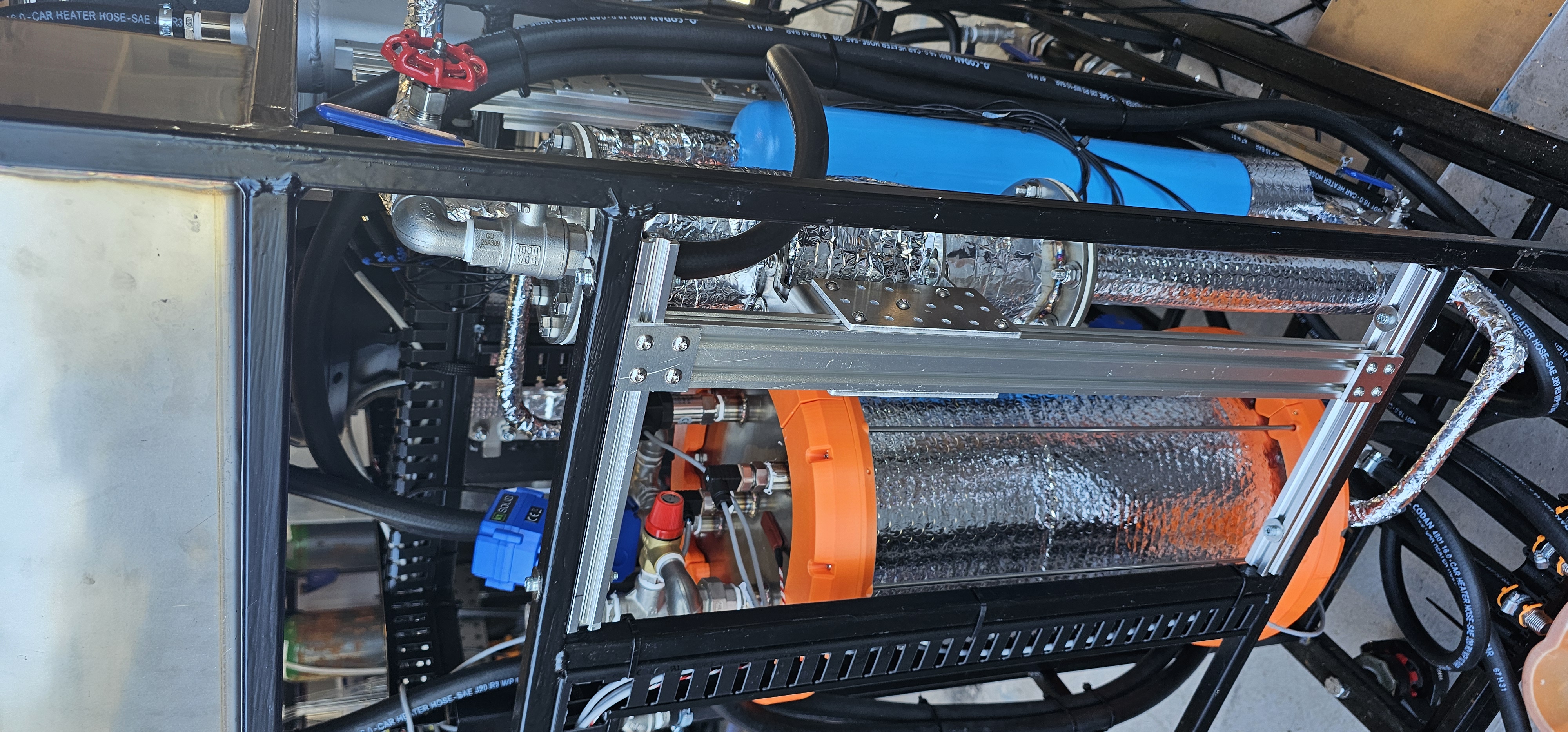
Our platform is intentionally accessible and reconfigurable. The aim at this stage is learning: shorten the loop between observation, modification and the next test.
Technology positioning | Principle-level view
Direct air capture systems differ in how they contact air, release captured CO2, use energy and progress towards scale. Air View is developing a configurable solid-sorbent platform in which the major process functions can be developed independently, integrated as a complete system and adapted around real deployment requirements.
A reusable capture medium removes CO2 from ambient air before controlled regeneration releases it for downstream handling.
Major process functions can be tested, maintained and improved independently while operating together as a complete platform.
Air View treats regeneration efficiency and the connections between subsystems as central engineering challenges, not downstream considerations.
The route forward progresses from an integrated pilot into defined operating environments, generating evidence before committing to commercial configuration or volume.
This describes Air View's engineering approach, not a quantified performance comparison. Energy, capture and cost advantages remain subject to defined testing and validation.
Development and validation
This scorecard separates grant-supported development from current integration work and the evidence still required. It reports the programme as it is, without turning prototype observations into commercial performance claims.
The 2023 Innovate UK Smart Grant supported development of an innovative air-movement platform and small-scale DAC hardware.
Define controlled test conditions and quantify airflow, capture behaviour and repeatability.
The 2025 Innovate UK Smart Grant supported development of a regeneration approach designed to reduce energy requirements, alongside regeneration-chamber development.
Quantify cycle performance, energy inputs and material behaviour under controlled operating conditions.
The regeneration programme expanded beyond an individual chamber into a modular architecture bringing the principal process functions together.
Translate the completed architecture into site-specific interfaces for demonstration operation.
The pilot system shown on this site brings the principal process elements together in an accessible, instrumented and reconfigurable platform.
Deploy the pilot into a defined site context and generate independently reviewable demonstration data.
Storage and utilisation create distinct downstream opportunities, with different requirements for conditioning, accounting and commercial partners.
Test purity, recovery and conditioning requirements against a defined storage or utilisation partner specification.
Prototype observations inform engineering decisions; they are not presented as verified tonnes of carbon removal.
Define system boundaries, lifecycle accounting, auditable metering and a route to independent review.
Public development snapshot | July 2026. Status reflects the non-confidential evidence position. It is not a certification, technical-readiness rating or performance guarantee.
View the forward roadmapDifferentiation through evidence
Potential advantages only become differentiators when they are measured at defined system boundaries and reproduced under relevant operating conditions.
Measured energy input per tonne of captured CO2 within defined system boundaries.
Operating-cost assessment and the next scale configuration.
Capacity, recovery and material behaviour across repeated operating cycles.
Sorbent selection, operating strategy and maintenance intervals.
Comparative subsystem testing followed by integrated operating results.
System configuration, serviceability and component-development priorities.
Commissioning and operation against the constraints of a defined demonstration environment.
Deployment readiness, interface requirements and future host-site selection.
Purity, recovery and conditioning results against a storage or utilisation specification.
Downstream partner, product route and commercial pathway selection.
Build time, component cost, maintainability and repeat-build learning.
Commercial configuration, manufacturing route and capital planning.
No target or comparative performance values are implied. Public results will require stated boundaries, methods and validation status.
Forward development roadmap
Gates 1-3 have established the engineering foundation and the pilot system shown on this site. The forward programme now begins with site integration and representative demonstration.
Pilot system developed
Subsystem architecture, end-to-end integration and construction of the pilot system.
Grant-supported engineering development and the assembled pilot hardware shown in the workshop images.
A real system that can now be integrated into a defined site and demonstration programme.
Engineering record Air movement, capture hardware, solid-sorbent regeneration and modular process integration.
Public position Pilot construction is complete; protected performance evidence remains subject to further validation.
Site integration and demonstration
Define utilities, safety, controls, physical interfaces and the storage or utilisation destination for captured CO2.
A reviewed site-integration package followed by commissioning, sustained operating data and independently reviewed measurements.
Evidence for customer offtake discussions, commercial product design and replication planning.
Partner role Host site, utilities and process integration, independent verification and downstream CO2 acceptance.
Investment role Site engineering, deployment, commissioning and the demonstration evidence programme.
Commercial and manufacturing readiness
Design for manufacture, serviceability, quality control and repeatable deployment.
A costed product configuration, qualified supply chain, deployment package and route to carbon-accounting verification.
Commercial units, structured offtake and licensing or integration partnerships.
Partner role Manufacturing, certification, project delivery and commercial channels.
Investment role Productisation, supply-chain capacity and first commercial deployments.
Engineering foundation complete. Gates 1-3 are consolidated because the pilot system has been built. Timing for Gates 4-5 remains evidence-led and intentionally avoids unsupported dates, scale claims or performance targets.
Discuss a roadmap roleInvestor context | Gate 4
The public investment case is not a projection of future scale. It is a defined sequence: build on the completed pilot, fund the next work, retire specific uncertainties and use the resulting evidence to make a better Gate 5 decision.
A built, integrated pilot; two Innovate UK Smart Grant programmes; an in-house engineering team; and a defined forward roadmap.
Starting pointSite-interface engineering, installation, commissioning, instrumented operation and an appropriate independent review route.
Work programmeThe programme is intended to replace important technical and deployment assumptions with measured, reviewable evidence.
Evidence questionsA reference demonstration and a stronger evidence base for product, manufacturing, customer and commercial pathway decisions.
Gate 5 inputsGate 4 should test the requirements of a defined downstream route. The commercial model depends on where the CO2 goes and what claim can credibly be made.
Potential value through high-integrity removal sales, buyer offtake and capture-and-storage partnerships where permanence and accounting requirements are met.
Potential value through CO2 supply, process integration, licensing or value-sharing where product specifications and lifecycle economics support a credible application.
Partnership opportunity map
Air View has built the pilot. The next stage depends on focused collaborations that connect it to a site, a CO2 destination, independent evidence and a route to repeatable manufacture.
An integrated pilot, an engineering team and a defined demonstration evidence programme.
A representative site, utilities, operational context and site-safety expertise.
A commissioned field demonstration and evidence from a real operating environment.
Modular process architecture, pilot learning and defined instrumentation requirements.
Automation, controls, utility integration, commissioning and industrial operating experience.
Reliable site integration and a more robust basis for replicated deployment.
A captured-CO2 pathway and an engineering interface that can be developed toward a defined specification.
Storage, mineralisation or utilisation requirements, plus transport, acceptance or offtake capability.
A credible destination for captured CO2 and a defined removal or utilisation revenue route.
Instrumented pilot operation, defined system boundaries and transparent development claims.
Independent measurement, lifecycle assessment, carbon accounting and technical scrutiny.
Auditable evidence for future buyers, investors, certification and commercial decisions.
Pilot design, engineering learning and protected system know-how.
Design-for-manufacture, fabrication, qualified components, quality control and service capability.
A costed, serviceable and repeatable commercial system configuration.
Do you recognise where your organisation fits?
Insights and evidence
A monthly-reviewed collection connecting carbon-removal market data, Air View's development record and the decisions that shape credible deployment.
Carbon-removal demand is becoming visible in contracts. The harder measure is how much has been physically delivered.
Read the articleHow two Innovate UK Smart Grant programmes progressed from defined engineering challenges into the pilot shown on this site.
Read the articleCaptured atmospheric CO2 can be stored or used, but the commercial opportunity and climate claim are not the same.
Read the articleWe separate development status, external market data, illustrative material and validated performance. Each has a different evidential weight and update trigger.
Hardware, roadmap and development statements change when a build, programme gate or public evidence position materially changes.
Current public status | Integrated pilot builtMarket figures retain their source, scope and snapshot date so visitors can distinguish current external data from Air View's own engineering work.
Current snapshot | CDR.fyi | 17 July 2026Conceptual charts and future pathways are identified as illustrative. They are not presented as historical data, forecasts or investment projections.
Purpose | Explain relationships, not predict outcomesQuantified capture, energy and carbon-removal claims require defined system boundaries, controlled measurements and an appropriate route to independent review.
Current position | Validation requiredThe people building Air View
Air View is being built by engineers who move between design, fabrication, assembly and commercial development-not by a team separated from the physical system.
An engineer and entrepreneur working across systems development, practical fabrication and the route from prototype to infrastructure.
Simon co-founded Air View Engineering in 2021 after graduating from Swansea University with a First-Class MEng in Mechanical Engineering. He has significant hands-on experience in systems development, mechanical assembly, MIG and TIG welding, 3D design and additive manufacturing.
His work also includes techno-economic model development and financial forecasting, connecting engineering choices, energy use, manufacturing assumptions and deployment scenarios to potential system cost and commercial viability.
Named as an inventor on Air View Engineering's published CO2 adsorption patent application, Simon has helped move the company from university research through two Innovate UK Smart Grant programmes and into integrated pilot-system development.
A mechanical engineer combining computational insight with practical product development and system integration.
Matthew co-founded Air View Engineering after graduating from Swansea University in 2020 with a First-Class MEng in Mechanical Engineering. His work centres on technical development, computational modelling and the adaptation of advanced additive-manufacturing methods.
Named as an inventor on Air View Engineering's published CO2 adsorption patent application, Matthew has helped guide technical development as the company progressed from its joint Master's research project through grant-supported development and into an integrated pilot system.
Carbon integrity
Energy, materials, transport and downstream handling belong in the carbon balance-not outside it.
Prototype observations are learning signals. Verified removal claims require defined boundaries and auditable data.
Capture is one part of the chain. Storage pathway, permanence and monitoring must be considered from the start.
Build the next stage with us
Partners and investors see the same engineering work. The conversation changes according to what each can help make possible.
We want to hear from deployment sites, low-carbon energy providers, storage and integration partners, researchers and independent technical specialists.
This route is intended for organisations with a relevant operating site, process interface, CO2 destination, technical capability or independent validation role.
An integrated, reconfigurable pilot; a completed development foundation; practical in-house engineering capability; and a Gate 4 programme organised around defined evidence needs.
A safely commissioned demonstration in a defined context, producing useful operating evidence and a clearer route to the next technical or commercial decision.
We welcome confidential conversations with investors who understand that credible climate infrastructure is built by retiring technical risk milestone by milestone.
This route is intended for climate-tech, industrial and infrastructure investors comfortable with prototype-stage development and milestone-led technical risk reduction.
The development record, pilot-system status, completed and upcoming evidence gates, scale-up logic and commercial pathway assumptions-subject to appropriate confidentiality.
Gate 4 is designed to replace site-integration and operating uncertainty with reviewable demonstration evidence, informing commercial and manufacturing readiness work at Gate 5.
Partner and investor enquiries | info@airviewengineering.co.uk
Start a focused conversation
Use this form for partnership opportunities, investor relations and other serious enquiries. We will route your message to the right conversation.
Prefer email? info@airviewengineering.co.uk
Air View Engineering
Air View Engineering Ltd is a UK prototype-stage engineering company developing direct air capture technology. Our approach is practical, test-led and open about where the work stands.
This website intentionally describes the system at principle level. Technical disclosures and performance data will follow validation.